Loading...

Mobile App Development Services

Mobile application development is the work of designing, building, and launching a native or cross-platform product for Android and iOS.

We have been at this since 2002, working as a mobile app development company for government departments, NGOs, and private businesses that needed apps able to take real traffic without falling over.

Many apps do not fail because the code was bad. They fail because the team stopped thinking about the product the moment it went live. What decides whether an app survives is what happens later, once the user count climbs and requirements start changing in ways nobody predicted at kickoff. Getting this right early is what lets us transform an idea into a product that can actually scale, and it shapes how we approach every project from the first meeting onward.

We have shipped native apps, cross-platform builds in Flutter and React Native, and complex government systems with a lot of moving parts. Each project looks different, but the goal is the same: create something structurally sound before worrying about anything else, so a small idea has room to convert into something bigger down the line.

Scalable Mobile App Development

Industries We Serve

From government systems to retail checkout flows, we build mobile products around the real constraints of each industry.

Government & Public Sector

Government mobile app development comes with its own set of rules around data handling and compliance. We build with those requirements in mind from the outset rather than fixing them in after a review.

Healthcare

Healthcare apps deal with sensitive information, so privacy has to come first. That said, we still put real effort into usability, whether the app is patient facing or an internal clinical tool.

Fintech & Banking

Banking apps need to move fast and stay locked down. A secure mobile application in this space follows the encryption and audit standards financial clients expect going in, not added on afterward.

E-commerce & Retail

A slow or clunky checkout is often all it takes to lose a sale. We tune retail apps for speed and personalization and connect them properly with the systems a store already uses.

Logistics & Supply Chain

Anyone managing a fleet of trucks needs tools that do not lag. We build tracking, routing, and dispatch apps where reliability comes before extra features.

Education & NGOs

App development for NGOs usually means working with tight budgets, though the needs are no smaller for it. We have built donor platforms and learning tools sized around actual funding rather than a wish list.

Manufacturing & Enterprise

Internal tools rarely get much credit, but they keep daily operations running more than people realize. Many of these builds involve ERP integration mobile apps, tying into systems a business already relies on and following how a team actually works day to day.

Mobile App Development Solutions We Offer

From native builds to offline-first architecture, we cover the full stack of mobile application development your product needs to launch and keep improving.

Native iOS and Android Development

Native iOS & Android Development

Some apps need everything the hardware can offer: heavy graphics, camera access, sensor-based features. Native iOS app development and native Android app development still outperform a cross-platform build for these cases. It costs more upfront, but when speed and hardware access matter more than budget, it is usually worth it.

Cross-Platform App Development

Cross-Platform App Development

Building the same app twice for two platforms wastes money most businesses could spend elsewhere. With cross-platform app development, we write it once using Flutter app development or React Native development, and it runs on both Android and iOS from a single codebase. Development time drops, cost drops, and for most business apps nobody notices much of a difference in quality.

Custom Mobile App Development

Custom Mobile App Development

Off-the-shelf software assumes your business works a certain way. Sometimes it does not. In that case, we build around the actual workflow instead of asking the workflow to bend around the software, keeping the design flexible enough to grow with the business later.

Enterprise and Government Mobile Solutions

Enterprise & Government Mobile Solutions

Enterprise app development brings its own scale of requirements: multi-department approvals, audit trails, governance rules that shift from client to client. We plan around all of that from the start of a project, not after a compliance officer flags something halfway through.

UI UX Design for Mobile Apps

UI/UX Design for Mobile Apps

A screen can look great and still fail if people cannot find what they came for. Our approach to mobile app UX UI design is grounded in how users actually behave, when we have that data, and in solid judgment when we do not. The goal is navigation nobody has to think twice about.

API Integration and Backend Systems

API Integration & Backend Systems

Users never see the backend, but it is often the part that decides whether an app can handle real traffic. Our mobile API integration work covers server-side systems and outside services an app needs, keeping data moving correctly, as more pieces are added over time.

App Modernization and Optimization

App Modernization & Optimization

An old app does not automatically need a rebuild. Sometimes it just needs restructured code underneath, a performance tune-up, and a fresher interface. That combination alone can make a five-year-old product feel current again.

Offline-First and Low-Bandwidth Experiences

Offline-First & Low-Bandwidth Experiences

Not everyone has a strong signal, and an offline-first mobile app should not fall apart because of it. We build smart synchronizing and lightweight architecture so core features keep working, which matters most for app development in low-connectivity regions where signal drops are routine. A low-bandwidth mobile application built this way catches up automatically once the connection comes back.

Mobile Security and Compliance

Mobile Security & Compliance

Adding security after launch rarely works as well as building it in from day one. We write with secure coding standards from the first commit and check mobile app security compliance against relevant rules the whole way through, not just at the end.

Analytics Monitoring and Feedback Loops

Analytics, Monitoring & Feedback Loops

The real learning happens after launch, not before. Monitoring and usage data show what people ignore, what they use constantly, and where they give up halfway. Updates get built from that, not from guesswork about what users probably want.

Maintenance Updates and SLA Support

Maintenance, Updates & SLA Support

Every app needs upkeep eventually. Our mobile app maintenance services cover bug fixes, performance checks, and SLA mobile app support with defined response times, keeping a product running well after everyone's forgotten about launch week except the support team.

Our 7-Step Mobile App Development Process

A clear process keeps projects on track from strategy through launch and ongoing support.

01

Strategy and Research

Before any design work or coding starts, we analyze the business, its users, and what competitors are already doing. Skip this step and you usually end up with a long feature list instead of an actual strategy. What comes out of this stage is a roadmap tied to specific business goals, not guesswork.

02

Analysis and Planning

Once the strategy is agreed on, we plan it out into technical requirements, timelines, and resourcing. This is what keeps a project from drifting into scope creep a few weeks in, which happens more than clients expect. You leave this stage with milestones we can both be held to.

03

UI/UX Design

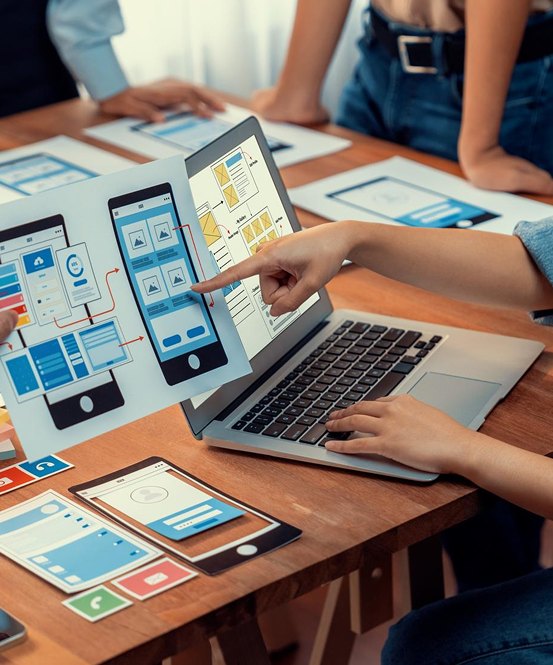
We design wireframes and prototypes around how people actually move through mobile apps, which is often different from how a brief assumes they will. Bad navigation is one of the fastest ways to lose someone's attention, so this stage gets real time. It wraps up with a tested design ready for development.

04

App Development

Depending on the project, we develop in native code, Flutter, or React Native. This is the stage where the approved design and technical spec actually turn into a working product, not a rough version of one.

05

Quality Assurance (QA) and Testing

We test every build here for functionality, performance, security, and device compatibility. Finding bugs at this stage is a lot less painful than finding out about them from your users after launch.

06

Deployment and Launch

App store submissions, server setup, everything needed to deploy and go live happens in this step. When it is done right, launch day is almost boring, which is kind of the point.

07

Maintenance and Updates

The work does not stop once the app is live. We maintain it as the user base grows and requirements shift, keeping an eye on performance, pushing updates, and fixing issues as they turn up.

Technologies We Use to Build Scalable Mobile Applications

We pick the stack based on what the product actually needs, whether that means shipping fast with Flutter or going fully native for performance-critical work.

Mobile Development Frameworks

Flutter, React Native, Native Android (Kotlin, Jetpack Compose), Native iOS (Swift, SwiftUI). Which one gets used depends entirely on the project. Sometimes it is about getting to market fast, other times only native performance will do.

Backend & Integration Layer

REST APIs, GraphQL, Firebase, AWS/Azure/GCP, PostgreSQL/MongoDB. We use this layer to integrate and keep data correct and available across everything the app touches, including any ERP integration for mobile apps that ties into existing business systems.

Performance & Security Layer

OWASP MASVS-aligned practices; performance-monitoring tools, architecture built to scale and secure the product as it grows. None of this matters much on day one. It starts mattering once real traffic shows up, and that is when we deploy the monitoring that keeps things stable.

Why Teams Trust TW for Mobile App Development

The right development partner does not just ship code; they stay with the product as it grows. Here is what makes Technology Wisdom the right choice for teams that want more than a one-off build:

1

Growth is planned into the architecture early, so a sudden jump in users does not turn into an emergency rebuild six months later. We ensure the foundation can carry that weight from day one.

2

Interface decisions come from watching how people actually use apps, not from guessing. That tends to be the real reason someone keeps an app instead of deleting it after a week.

3

You get clear milestones and regular updates, with no surprise changes showing up halfway through that nobody mentioned earlier.

4

As a development partner, one team on our side covers strategy, build, launch, and everything after, so you are not stuck managing separate vendors for design, development, and maintenance.

5

Technical decisions are judged by what they actually align with for the business, not by whether they happen to be an interesting problem to solve. It is part of why clients keep coming back to the same team project after project, and why our support does not end when the invoice does.

Why Choose Technology Wisdom for Mobile Apps

Frequently Asked Questions

It depends a lot on complexity. A simple cross-platform app costs a fraction of what a custom enterprise-grade system runs. We will give you a real number on the total investment once we understand the actual scope, not before.

App development timeline usually falls somewhere between three and nine months. A lean MVP can move quickly. A government system with several integrations takes longer, and that is just the nature of the work.

Most businesses do not run on workflows a generic template was built for. Custom development shapes the app around the business rather than asking the business to adjust to whatever the software happens to do.

Need heavy graphics or sensor-driven features? Go native. Building a standard business app? Cross-platform will probably get you there faster and for less money, and most users will not notice the difference anyway.

Neither is objectively better. Flutter renders a touch faster and keeps the UI more consistent across platforms. React Native has a bigger community behind it and plugs into existing JavaScript projects more easily. Pick based on what your team already knows how to use.

Yes. SLA-based plans cover bug fixes, performance monitoring, and ongoing updates once the app is live.

    Book A Free Consultation

    By Submitting This Form, You Agree To Our Privacy Policy