
Designing the Digital Foundation for Bosnia and Herzegovina's National Energy & Climate Monitoring Framework
Project Facts
Client: GIZ – Decarbonization of the Energy Sector in Bosnia and Herzegovina (DecES)
Country: Bosnia and Herzegovina
Sector: Energy, Climate Change, Digital Governance
Technology Wisdom Role: System Analysis, Requirements Engineering, Process Modelling, System Architecture Design
Project type: System Requirement Specification (SRS) and Digital Platform Architecture
Core Deliverables
- System Requirement Specification (SRS)
- Use Cases
- Functional Requirements
- Non-Functional Requirements
- BPMN Process Models
- Common Architecture Framework
- User Profiles and Access Models
- Data Field Definitions
- Support & Maintenance
- Stakeholder Mapping
- Future System Architecture Recommendations
Sustainable Development Goals
- SDG 7 – Affordable and Clean Energy
- SDG 9 – Industry, Innovation and Infrastructure
- SDG 13 – Climate Action
- SDG 16 – Peace, Justice and Strong Institutions

Overview
Bosnia and Herzegovina is working toward its energy transition and climate commitments under the Energy Community Treaty and broader European climate frameworks.
To support these goals, the country needed a centralized Monitoring, Reporting and Verification (MRV) framework capable of tracking progress across multiple energy and climate dimensions including:
- Decarbonization
- Renewable Energy
- Energy Efficiency
- Energy Security
- Internal Energy Market
- Research, Innovation and Competitiveness
However, before such a digital platform could be developed, a detailed understanding of stakeholders, reporting obligations, indicators, business processes, user roles, and system requirements was required.
Technology Wisdom was engaged by GIZ to lead the pre-development phase and establish the foundation for a future national digital platform.
The Challenge
The challenge was not simply building a software system.
The challenge was defining a national framework that could coordinate data collection, reporting, verification, and monitoring across multiple ministries, institutions, regulators, and energy-sector stakeholders operating at different levels of government.
Bosnia and Herzegovina has a complex governance structure involving state-level, entity-level, and cantonal institutions. Energy and climate responsibilities are distributed across multiple organizations, making centralized reporting particularly difficult.
Without a clearly defined system architecture and requirements framework:
- Data collection processes would remain fragmented.
- Reporting responsibilities would remain unclear.
- Climate and energy indicators would be difficult to track consistently.
- Future software development efforts would carry significant implementation risk.
- Compliance with evolving European monitoring requirements would become increasingly difficult.
Technology Wisdom was tasked with transforming these fragmented processes into a structured and implementable digital blueprint.

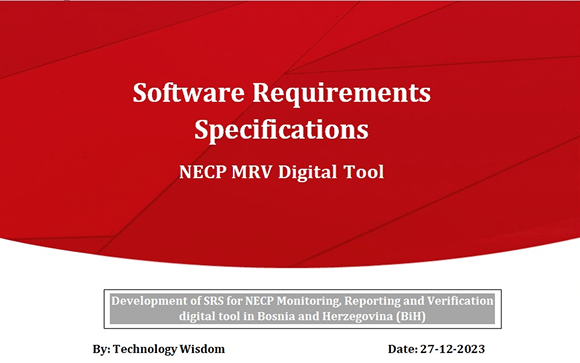
Technology Wisdom's Approach
Rather than jumping directly into technical design, Technology Wisdom adopted a structured requirements engineering approach.
The project began with stakeholder analysis, process discovery, and requirements gathering sessions involving key institutions and working groups responsible for energy and climate planning.
The team worked closely with GIZ and project stakeholders to:
- Understand reporting obligations
- Map information flows
- Identify system actors
- Define user responsibilities
- Document business processes
- Establish monitoring indicators
- Clarify reporting requirements
Through iterative workshops and consultations, all requirements were consolidated into a comprehensive System Requirement Specification framework.
Solution Delivered
Technology Wisdom delivered a complete pre-development documentation package for the future NECP MRV digital platform.
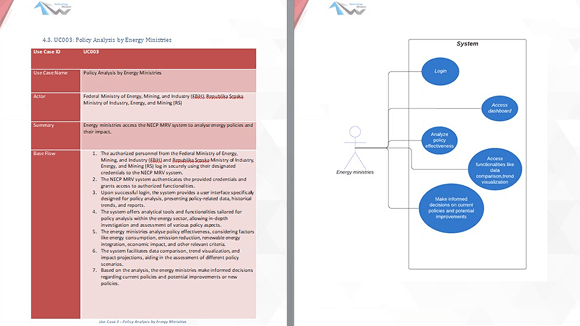
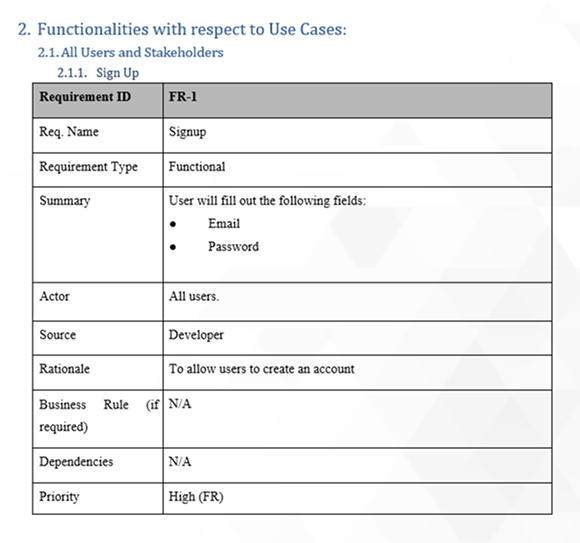
Use Case Development
The team developed detailed use cases describing how different stakeholders would interact with the future system.
Each use case documented:
- User roles
- Actions
- System responses
- Data flows
- Validation requirements
- Process interactions
This created a clear blueprint for future development teams.
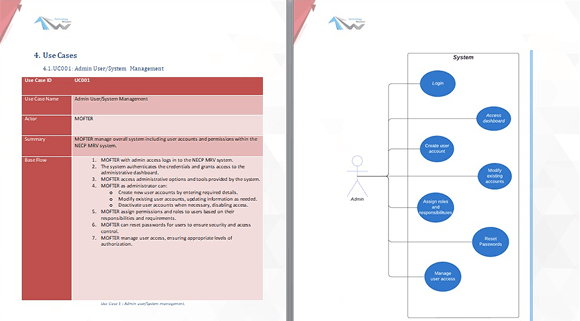
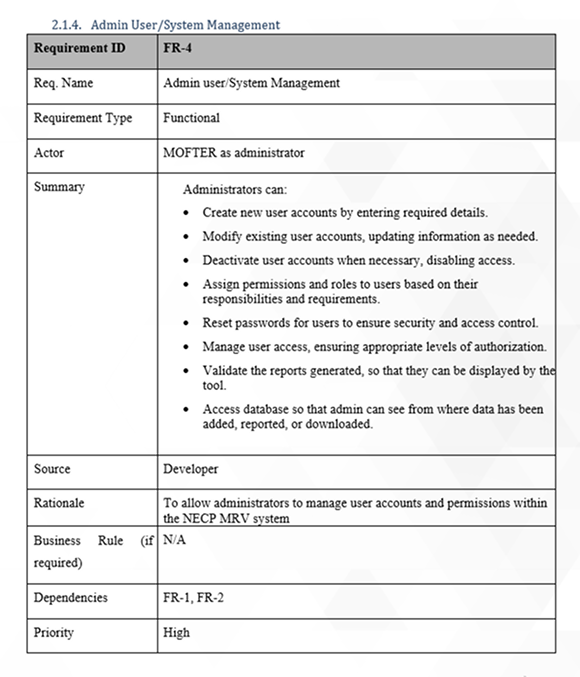
Requirements Engineering
A comprehensive set of functional and non-functional requirements was produced.
This included:
- User management requirements
- Data collection requirements
- Reporting workflows
- Security requirements
- Scalability requirements
- Performance expectations
- System integration requirements
The resulting requirements framework established a clear development roadmap for the future platform.
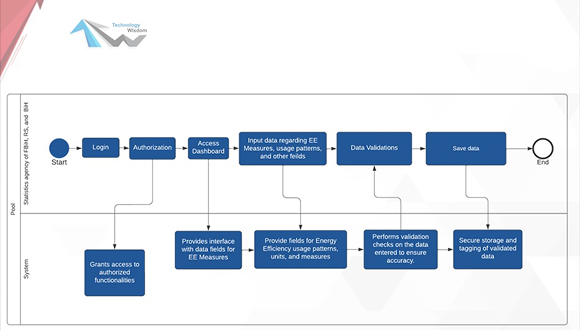
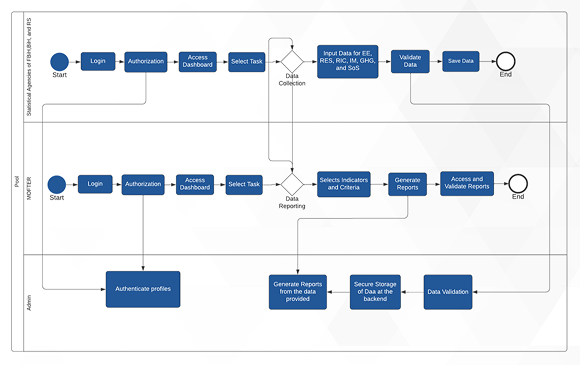
BPMN Process Modelling
Technology Wisdom developed detailed Business Process Model and Notation (BPMN) process models representing the operational workflows of the future MRV system.
These process models documented:
- Stakeholder interactions
- Reporting procedures
- Verification workflows
- Approval processes
- Data ownership responsibilities
The BPMN models provided a visual and standardized representation of how the future system would operate.
Architecture Framework
The project produced a Common Framework document that defined the future architecture of the platform.
This framework covered:
- System structure
- Component relationships
- User interfaces
- Service layers
- Business logic layers
- Data layers
- Security architecture
- External system integrations
The architecture framework provided a strong foundation for future implementation activities.
Indicator and Data Mapping
The platform needed to monitor a large set of national energy and climate indicators covering:
- Energy consumption
- Renewable energy adoption
- Greenhouse gas emissions
- Energy affordability
- Market competitiveness
- Research and innovation performance
Technology Wisdom supported the identification and structuring of these indicators into a format suitable for future digital monitoring and reporting.
Key Highlights
National-Level Digital Planning
Supported the preparation of a future national monitoring platform aligned with Bosnia and Herzegovina's climate and energy transition objectives.
Multi-Stakeholder Coordination
Contributed to requirements gathering across multiple government institutions, regulatory bodies, and thematic working groups.
European Framework Alignment
The proposed system architecture and reporting structure were designed to align with the monitoring and reporting requirements of Regulation (EU) 2018/1999 on the Governance of the Energy Union.
Future-Proof Architecture
Developed documentation that can serve as the implementation foundation for future software development, procurement, and expansion efforts.
Impact
The project established a structured digital roadmap for Bosnia and Herzegovina's future NECP Monitoring, Reporting and Verification ecosystem.
Key outcomes included:
- Centralized understanding of reporting processes
- Clearly documented stakeholder responsibilities
- Standardized system requirements
- Structured process models
- Future-ready architecture framework
- Reduced implementation ambiguity for future development phases
Most importantly, the project transformed a complex collection of institutional processes and reporting obligations into a documented and actionable digital blueprint.
Founder Perspective
“Successful digital transformation projects do not begin with coding.”
“They begin with understanding processes, stakeholders, responsibilities, and data requirements.”
“Through this engagement, Technology Wisdom helped establish the foundations for a future national digital platform by translating complex policy, reporting, and institutional requirements into a structured and implementable system blueprint.”
“The result was a comprehensive requirements and architecture framework capable of guiding future development efforts while supporting Bosnia and Herzegovina's long-term energy and climate objectives.”
— Muhammad Faisal Nisar, Founder & CEO
Our Impact
-
0+
Years in Business
-
0+
Years of Collective Experience
-
0+
Projects Delivered
-
0+
Clients Worldwide
-
0%
Client Satisfaction