
Project Facts
Client: GIZ – Support to Good Governance Programme (S2GG)
Programme Partner: Coalition of Ethiopian Civil Society Organizations for Elections (CECOE)
Country: Ethiopia
Project Duration: August 2025 – April 2026, followed by a three-month support period until 31 July 2026
Sector: Digital Governance | Democracy Support | Election Technology
Services Provided
Technology Wisdom provided end-to-end digital solution development and implementation services, including:
- Requirements Gathering & Refinement
- Implementation Concept Development
- UX/UI Design
- Web Application Development
- Mobile Application Development
- Observer Management System Development
- Data Migration Support
- API & Third-Party Integrations
- USSD Integration
- Dynamic Form & Checklist Development
- Polling Station Assignment
- Reporting & Dashboard Development
- Quality Assurance & Regression Testing
- User Acceptance Testing Support
- Technical Documentation
- User Guides & Video Tutorials
- Training & Knowledge Transfer
- Deployment & Post-Handover Support
Platforms
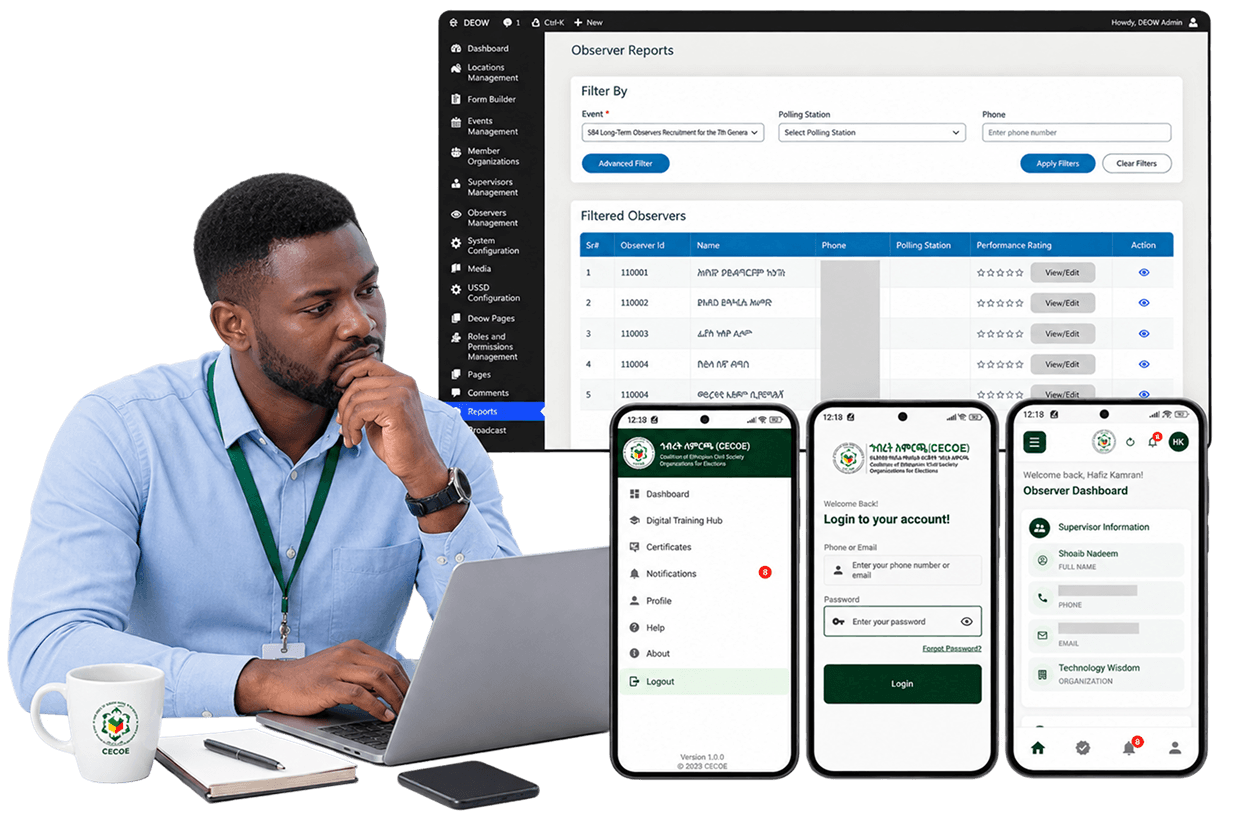
The Digital Election Observation Workspace was designed as a connected ecosystem rather than a single application.
- Web Platform A centralized workspace for CECOE, member organizations, supervisors, and administrators.
- Mobile Application A mobile solution supporting observer and supervisor workflows, including offline functionality for environments with limited connectivity.
- USSD Channel An additional communication and interaction channel designed to improve accessibility for users operating through basic mobile phones.
- Desktop Application A dedicated supporting application developed to address technical limitations associated with large-scale Word-to-PDF document conversion.
Technology Stack
Technology Wisdom built the DEOW solution using a combination of open-source technologies and custom development.
- WordPress Open-Source Base
- Custom PHP Themes & Modules
- MySQL
- React Native Mobile Application
- REST/API-Based Communication
- SOAP API Structure for USSD Integration
- jQuery
- Custom Desktop Application for Document Conversion
The project was initially required to build upon an open-source solution. However, the complexity of the election observation workflows required Technology Wisdom to combine existing open-source capabilities with substantial custom development.
Key Features
The final DEOW ecosystem included:
- Member Organization Registration
- Location Management
- Observer Recruitment
- Supervisor Management
- Event Management
- Dynamic Forms
- Unique Observer & Participant Identification
- Polling Station Assignment
- Dynamic Checklist Generation
- Bulk Checklist Processing
- Certificate Generation
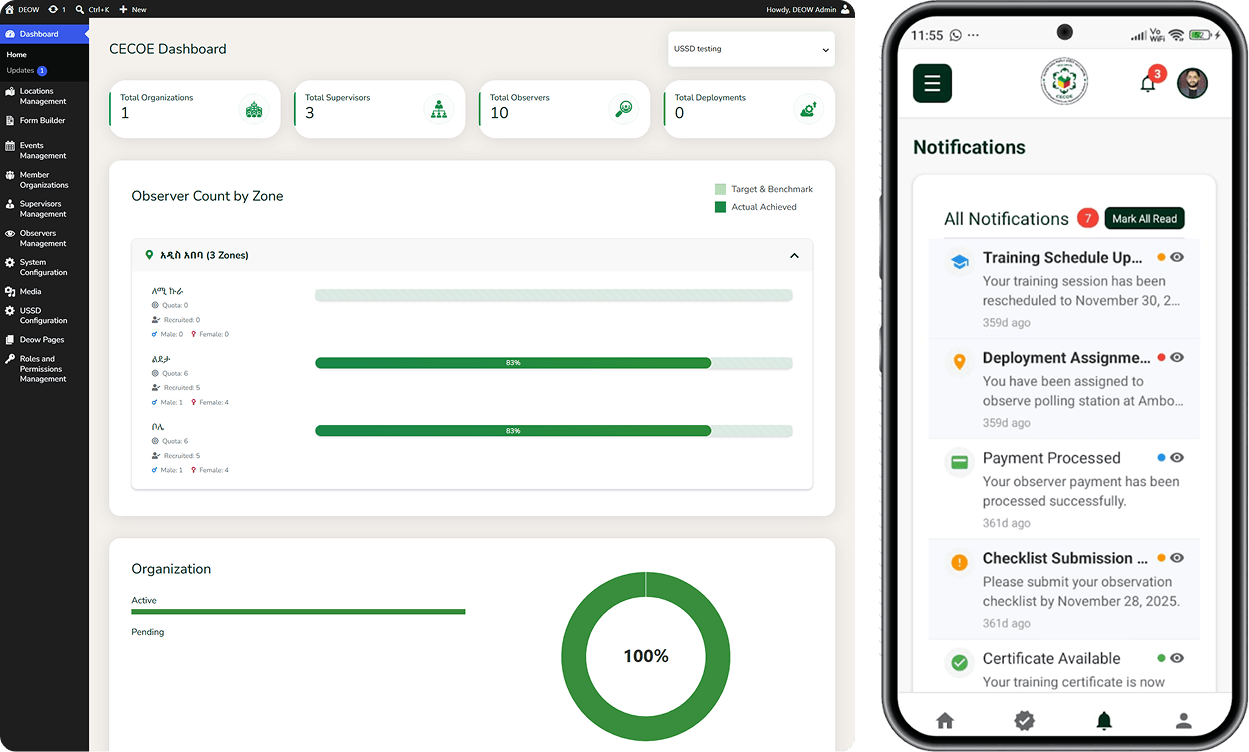
- Real-Time Statistics & Reporting via Dashboard
- Roles & Permissions Management
- Notifications & Broadcast Messaging
- Mobile Access
- Offline Functionality
- USSD Integration
- Apollo Integration
- NEBE API Integration
- SMS/OTP Workflows
- Training Resources
- User Documentation & Video Tutorials
The project brought these previously fragmented workflows into one centralized digital environment.
Project by the Numbers
- Designed to support approximately 5,000 observers
- Web + Mobile + USSD channels developed
- 3 major external integration areas: Apollo, NEBE API, and USSD
- 2 primary user support formats: written guides and video tutorials
- Multiple interconnected user roles: administrators, CECOE staff, member organizations, supervisors, and observers
Related Sustainable Development Goals
- SDG 9
- SDG 10
- SDG 16
- SDG 17
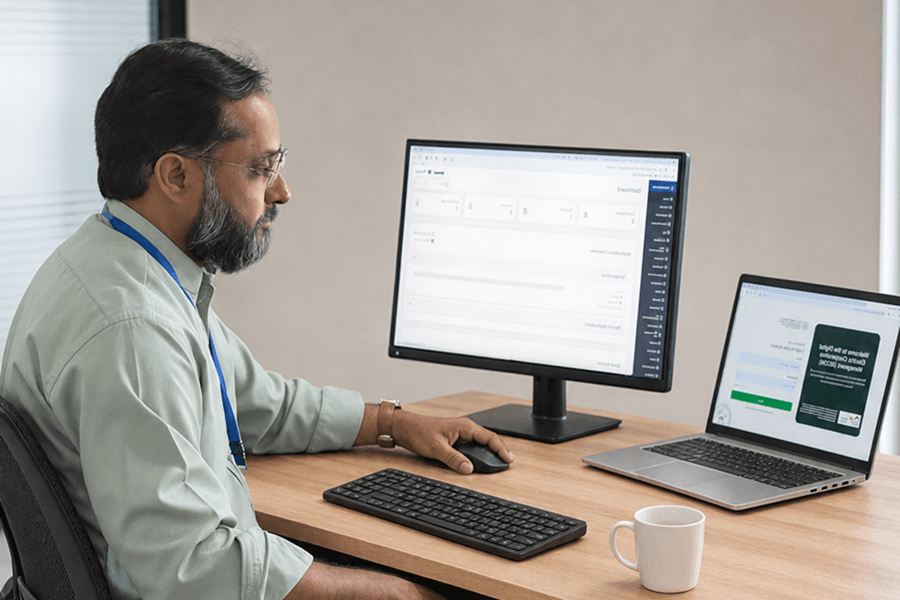
Overview
Election observation requires the coordination of thousands of people, multiple institutions, geographically dispersed locations, and time-sensitive information.
For CECOE, many of these processes had traditionally relied on fragmented tools and manual workflows. Observer recruitment involved spreadsheets and email-based communication. Location and participant data required manual preparation. Checklists could depend on manual document-processing workflows. Communication with observers often relied on phone calls and disconnected channels.
As the scale of election observation grew, so did the risks.
A system managing thousands of observers cannot depend indefinitely on disconnected Excel files, manual location assignments, repetitive document preparation, and fragmented communication. The margin for error becomes increasingly significant when observer records, events, polling locations, checklists, and reporting workflows must all remain connected.
Recognising the need for digital transformation, GIZ's Support to Good Governance Programme supported CECOE in developing the Digital Election Observation Workspace (DEOW).
Technology Wisdom was selected to transform this complex operational challenge into a centralized digital ecosystem capable of supporting observer recruitment, assignment, communication, management, reporting, and integration with other relevant systems.
The project was not simply about developing software.
It was about creating a practical digital backbone for a complex election observation ecosystem.
The Challenge
Before DEOW, many election observation processes were heavily dependent on manual systems.
Observer recruitment, data management, location assignment, participant identification, checklist generation, and communication were handled through a combination of Excel spreadsheets, email exchanges, manual processes, and separate tools. The limitations were significant.
- Manual observer recruitment created the possibility of duplicate or incomplete records.
- Manual polling station assignment increased the risk of assigning observers incorrectly.
- Managing multiple events and locations required complex coordination.
- Generating checklists and participant information could involve repetitive document-processing work.
- Different user roles created additional permission and access-management challenges.
- Data required by other systems could require manual preparation and re-entry.

The official project concept therefore aimed to replace fragmented manual workflows with a centralized and automated platform. The ToR specifically identified manual Excel-based recruitment, data management, participant-set generation, checklist creation, observer communication, and certification as workflows requiring digital transformation.
However, developing the system introduced a new layer of complexity.
The project requirements became significantly clearer after onsite discussions and detailed stakeholder engagement. The team discovered that the initial high-level scope needed to be transformed into detailed operational workflows covering observer recruitment, location management, event participation, unique IDs, integrations, dynamic forms, mobile access, and document generation.
Technology Wisdom therefore needed to build a solution that could:
- Manage approximately 5,000 observers
- Support multiple user roles and permissions
- Handle interconnected election events and locations
- Recruit observers through web and mobile channels
- Assign observers to polling locations
- Generate dynamic checklists
- Support bilingual document workflows
- Integrate with Apollo
- Connect with the National Election Board of Ethiopia (NEBE)
- Provide USSD access
- Support offline mobile functionality
- Process large volumes of documents
- Operate within hosting and infrastructure constraints
- Remain sufficiently flexible for evolving requirements
Without such a system, the risk of incorrect assignments, inconsistent data, duplicated records, inaccurate reporting, and fragmented coordination would remain high.
Technology Wisdom's Approach
Rather than treating the ToR as a fixed technical checklist, Technology Wisdom adopted an iterative and collaborative implementation approach.
One of the most important early activities was the onsite engagement in Ethiopia, where the team worked directly with stakeholders to translate high-level requirements into practical workflows.
This became a major turning point in the project.
The onsite discussions enabled the team to better understand how CECOE and its wider ecosystem managed locations, observers, events, participant IDs, checklists, reporting, and integrations. The detailed project scope was then refined around actual operational requirements rather than assumptions.
Technology Wisdom followed an Agile and phased development approach:
- Requirements Refinement
- Implementation Planning
- Wireframing
- Static Design
- Module Development
- Staging Deployment
- Testing & Quality Assurance
- Client Demonstrations
- Feedback & Refinement
- Production Deployment
- Training
- Handover
- Post-Deployment Support
The team maintained regular meetings with stakeholders throughout implementation, allowing the solution to evolve as requirements became clearer.
A particularly important design principle was flexibility.
Where possible, Technology Wisdom avoided hard-coded workflows. Dynamic forms, fields, event-related information, and administrative settings were designed to be manageable through the administration environment.
The project also required a hybrid development strategy.
The use of the existing open-source platform was maximized where appropriate, while developing custom functionality whenever existing capabilities could not support CECOE's election observation workflows.
Solution Delivered
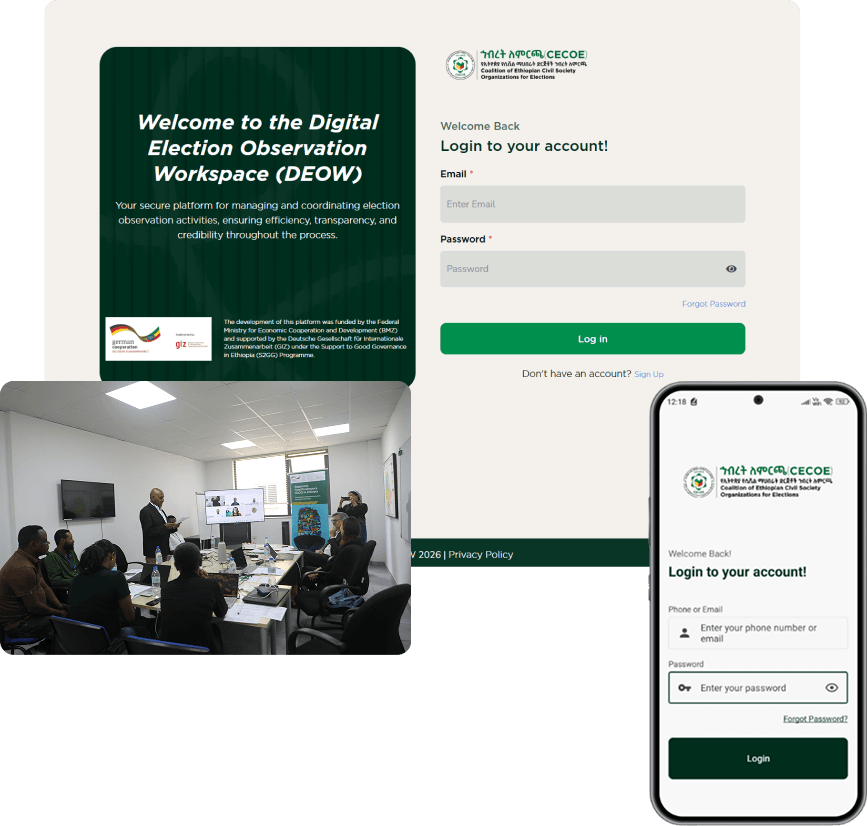
This project delivered a multi-platform Digital Election Observation Workspace supporting the complete observer management lifecycle.
The final solution included:
- A centralized web-based management system
- A mobile application with offline capabilities
- USSD functionality
- API-based integrations
- Dynamic forms and checklists
- Observer and event management
- Polling station assignment
- Real-time operational visibility
- Reporting capabilities
- Document and certificate generation
- Training resources
- Written and video documentation
- Post-handover support
The solution was developed through phase-wise delivery, moving from staging and testing environments to production following review and validation.
Centralized Observer Management
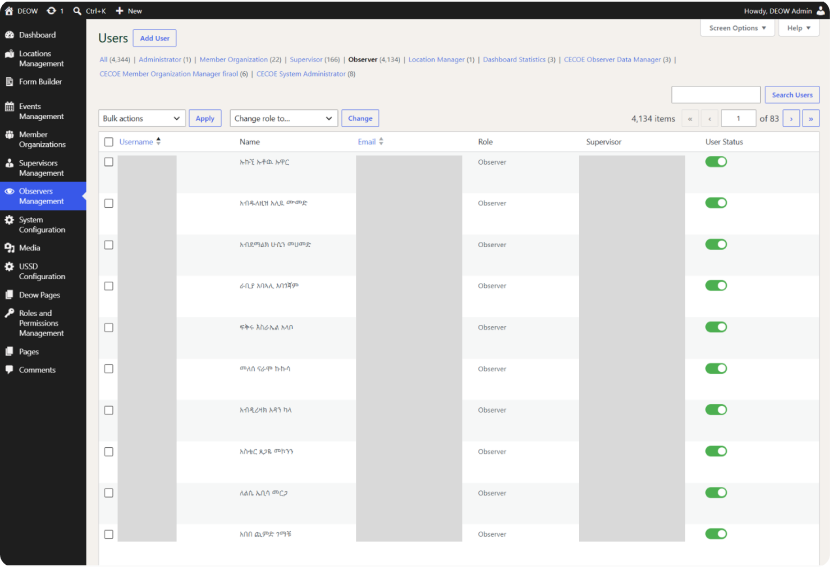
At the heart of DEOW was a centralized system for managing observers and the organizations supporting them.
The platform enabled CECOE and relevant user groups to manage observer information within one environment rather than across disconnected spreadsheets and manual files.
Key functionality included:
- Observer recruitment
- Observer profile management
- Unique participant and observer identification
- Event participation
- Location association
- Data filtering and management
- Role-based access
- Supervisor coordination
This centralized approach created improved visibility across the observer ecosystem and reduced the operational complexity associated with manually coordinating large numbers of individuals.
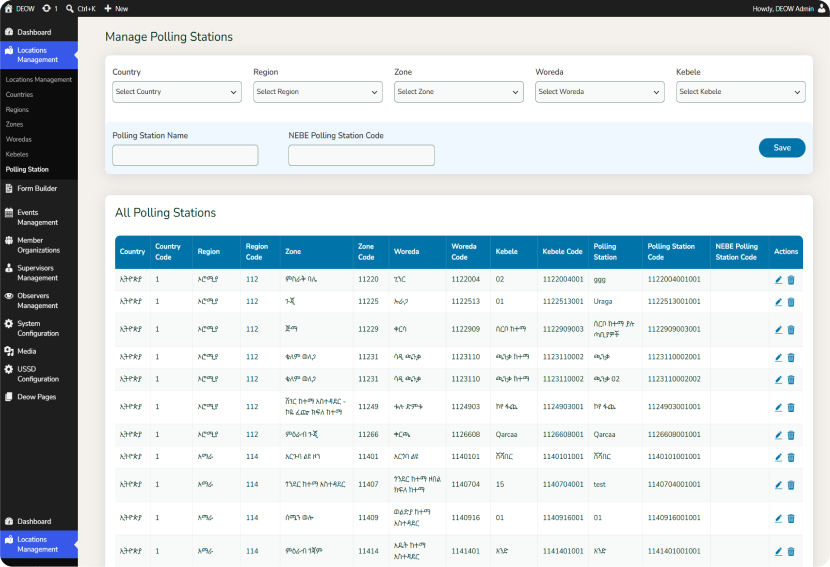
Smart Polling Station Assignment
Assigning the right observer to the right location is one of the most critical workflows in an election observation system.
Manual assignment processes can create significant risks, particularly when thousands of observers are being managed across different events and geographic locations.
The final system involved functionality to support structured polling station and location assignments based on the relevant observer, event, and location data.
The objective was not simply to digitize an existing spreadsheet.
The workflow was designed to create a connected process where relevant data could be managed and verified within the wider DEOW ecosystem.
This reduced reliance on manual location matching while improving operational visibility for administrators and supervisors.
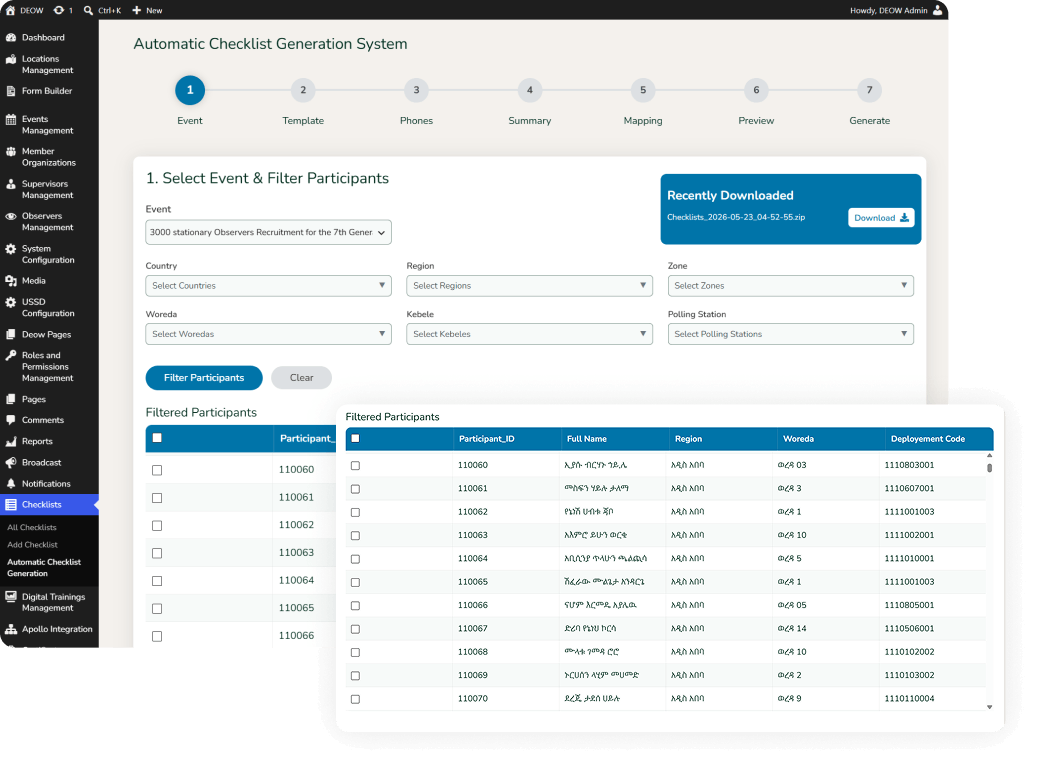
Dynamic Forms & Checklist Generation
Election observation processes require different information for different events, observers, and operational scenarios.
A rigid form structure would have required repeated system modifications whenever requirements changed.
The system developed dynamic and configurable workflows that enabled administrators to manage forms and relevant fields more flexibly.
The system also supported checklist generation linked to participant and observer data.
One of the project's technical challenges involved processing large numbers of documents.
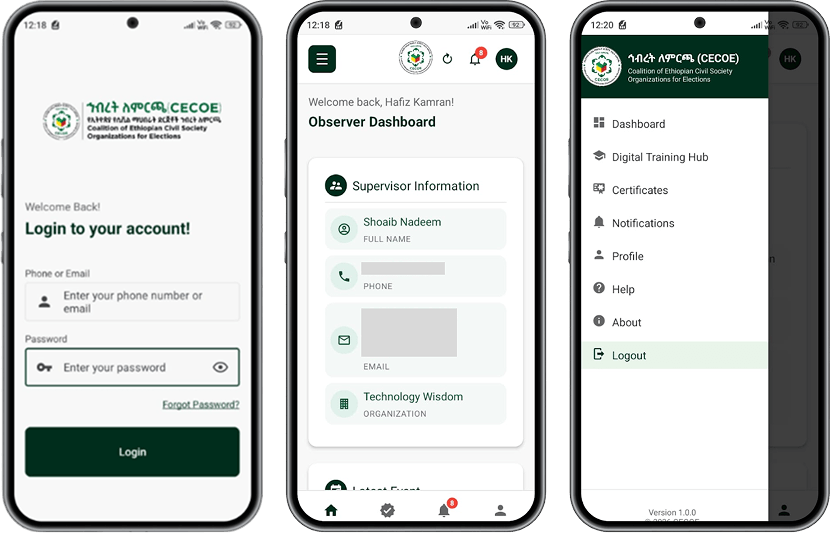
Mobile Application with Offline Capabilities
Election observation frequently takes place in environments where reliable internet access cannot always be assumed.
The project included the development of a mobile application supporting observer and supervisor workflows.
The mobile approach extended the DEOW ecosystem beyond desktop users and allowed key functionality to be accessed through smartphones.
The application included API-based communication with the wider DEOW platform and incorporated offline functionality to support users operating under variable connectivity conditions.
The mobile application was successfully deployed on the Google Play Store as part of the project implementation.
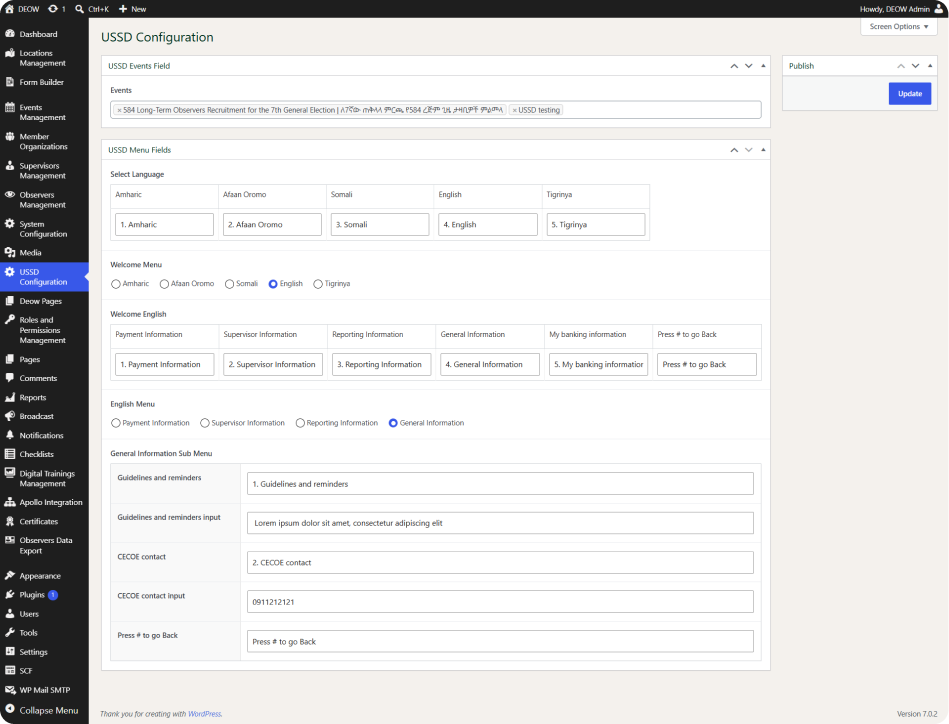
USSD Integration for Wider Accessibility
Not every user can be expected to access the system through a smartphone or constant internet connectivity.
To expand accessibility, DEOW also incorporated USSD functionality.
The USSD workflow was also developed to support dynamic and editable menu content rather than fixed menu structures. This gave administrators greater flexibility to manage information without requiring repeated software changes.
The implementation presented significant coordination challenges because it depended on third-party telecommunication infrastructure and responses from Ethio Telecom. Despite delays associated with external coordination, the dynamic USSD component was successfully delivered as part of the wider solution.
Integrating the Election Observation Ecosystem
DEOW was designed to operate as part of a wider digital ecosystem.
The DEOW ecosystem included integrations with:
Apollo
The system supported workflows connected to the Apollo environment, reducing the need to recreate relevant location and participant data manually.
NEBE API
The project included integration with the National Election Board of Ethiopia (NEBE), supporting the exchange of relevant observer and event-related information.
Mobile APIs
API-based communication connected the mobile application with the DEOW ecosystem.
SMS & OTP Workflows
Relevant notification and authentication workflows were incorporated where required.
These integrations were particularly important because disconnected systems often create duplicated work and inconsistent data.
The goal was therefore to create connected workflows rather than simply digitizing isolated processes.
Overcoming Infrastructure Limitations
One of the most important technical challenges emerged when the hosting environment could not support the required Word-to-PDF conversion processes.
Certain server-level tools and extensions needed for large-scale conversion were not available within the shared hosting environment.
Instead of leaving the functionality incomplete, Technology Wisdom made a strategic pivot.

This became a practical example of the team's approach throughout the project:
When the existing environment could not support the required solution, Technology Wisdom identified an alternative architecture rather than forcing an unreliable workaround.
The team also introduced chunk-based processing for large document workloads.
These adaptations enabled the project to continue despite infrastructure limitations that would otherwise have blocked critical functionality.

Quality Assurance & Regression Testing
Because DEOW consisted of interconnected modules, quality assurance was critical.
A change in one workflow could potentially affect observer management, permissions, event participation, mobile functionality, integrations, reporting, or checklist generation.
Technology Wisdom therefore integrated testing throughout the development lifecycle rather than treating quality assurance as a final project phase.
The QA process included:
- Test Scenario Development
- Test Case Preparation
- Web Application Testing
- Mobile Application Testing
- API Testing
- Android Testing
- Cross-Browser Testing
- User Role & Permission Testing
- Integration Testing
- Regression Testing
- User Acceptance Testing Support
- Production Verification
Each major module was tested in staging, issues were logged, fixes were verified, and regression testing was conducted before release.
This continuous QA approach helped identify defects before production deployment and reduced the risk of repeated production issues.
Training, Documentation & Knowledge Transfer
Technology projects are only sustainable when client teams can confidently operate and manage the systems after delivery.
The project included comprehensive knowledge-transfer activities.
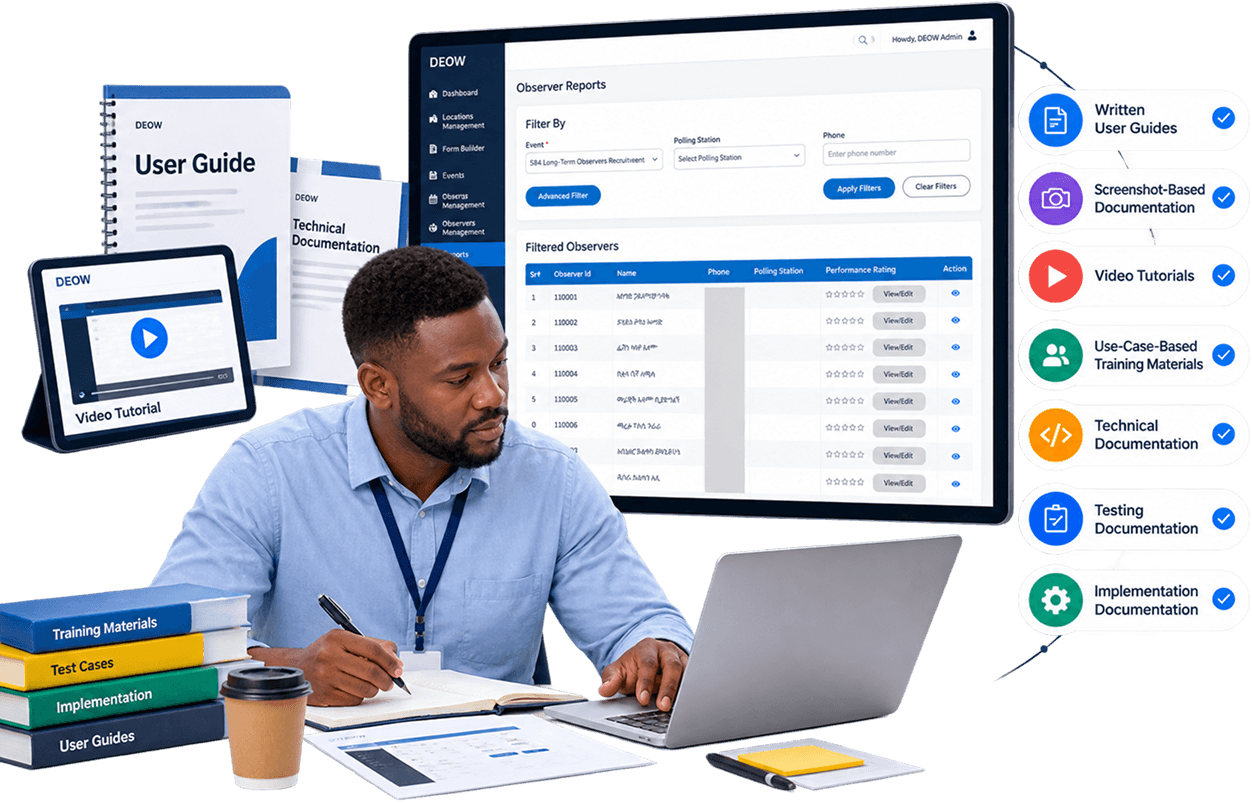
The team prepared:
- Written User Guides
- Screenshot-Based Documentation
- Video Tutorials
- Use-Case-Based Training Materials
- Technical Documentation
- Testing Documentation
- Implementation Documentation
The project also included a support period after handover.
Although final onsite delivery and training arrangements faced external approval challenges, Technology Wisdom continued to provide support and verify post-deployment issues during the agreed support period.
Results & Impact
The most significant transformation was the movement from fragmented manual workflows toward a centralized digital election observation workspace.
Processes that previously depended heavily on Excel files, emails, manual document preparation, and disconnected communication channels became part of an integrated system.
The platform enabled:
- More structured observer recruitment
- Centralized observer management
- Digital polling station assignment
- Dynamic checklist generation
- Improved user-role verification
- Better visibility across member organizations and supervisors
- Centralized event information
- Mobile access
- Offline functionality
- USSD accessibility
- More organized reporting
- Integration with external systems
The system was designed to support approximately 5,000 observers, enabling CECOE to manage a significant volume of election observation information within one environment.
Bulk processing also improved through the introduction of chunk-based workflows, while external integrations reduced the need to repeatedly recreate or manually transfer information.
The impact was not limited to technology.
By centralizing workflows, DEOW improved the operational visibility of observer, supervisor, location, and member organization information.
Certificate of Recognition · GIZ Ethiopia & CECOE
Client Recognition
GIZ and the Coalition of Ethiopian Civil Society Organizations for Elections (CECOE) issued a Certificate of Recognition to Technology Wisdom for its professional services in developing the Digital Election Observation Workspace (DEOW).
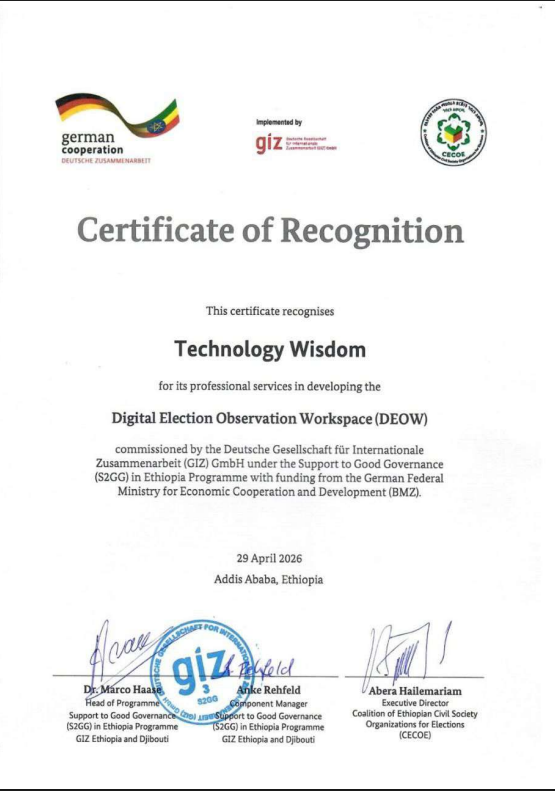
“This certificate recognises Technology Wisdom for its professional services in developing the Digital Election Observation Workspace (DEOW), commissioned by the Deutsche Gesellschaft für Internationale Zusammenarbeit (GIZ) GmbH under the Support to Good Governance (S2GG) in Ethiopia Programme with funding from the German Federal Ministry for Economic Cooperation and Development (BMZ).”
— Dr. Marco Haase, Head of Programme, Support to Good Governance (S2GG) in Ethiopia Programme, GIZ Ethiopia and Djibouti
— Anke Rehfeld, Component Manager, Support to Good Governance (S2GG) in Ethiopia Programme, GIZ Ethiopia and Djibouti
— Abera Hailemariam, Executive Director, Coalition of Ethiopian Civil Society Organizations for Elections (CECOE)
Why This Project Was Different
DEOW was not a conventional website or standalone mobile application.
It was a complex digital transformation project operating at the intersection of:
- Election Observation
- Civil Society Coordination
- Digital Governance
- Mobile Technology
- Offline Access
- Large-Scale Data Management
- Third-Party Integration
- Role-Based Security
- Document Automation
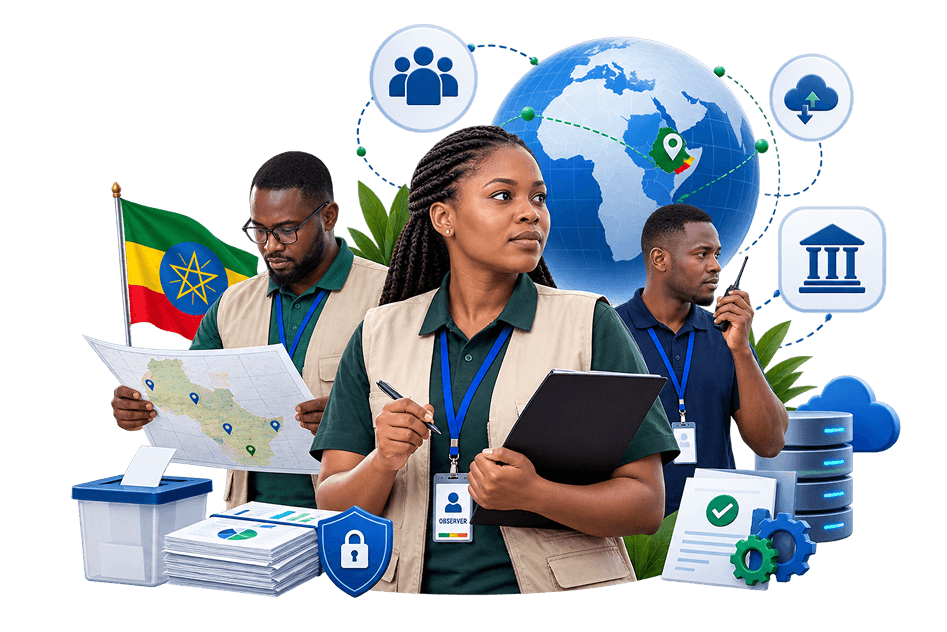
The project also demonstrated the importance of adapting technology to real operational conditions.
The team had to manage evolving requirements, open-source platform constraints, hosting limitations, third-party dependencies, large document workloads, mobile access requirements, and cross-platform communication.
Rather than allowing these constraints to define the limits of the project, Technology Wisdom repeatedly adapted the solution.
The desktop conversion application, chunk-based document processing, dynamic USSD menus, configurable forms, and custom modules were all examples of technology decisions shaped by operational reality.
Lessons & Insights
The project reinforced several important lessons for complex digital transformation initiatives.
Requirements Discovery Cannot Be Replaced by Documentation Alone
The onsite engagement in Ethiopia played a major role in transforming a high-level project scope into detailed, workable requirements.Open Source Does Not Always Mean Simple
Using an existing open-source foundation provided a starting point, but extensive customization was still required to support highly specific workflows.Infrastructure Decisions Matter
Shared hosting limitations directly affected document-processing functionality, demonstrating the importance of evaluating infrastructure requirements early.
Third-Party Dependencies Need Additional Planning
USSD implementation depended on external telecommunication coordination, reinforcing the need to build timeline buffers around third-party integrations.
Continuous QA Is Essential
Interconnected systems require repeated regression testing because changes in one module can affect other workflows.
Flexibility Creates Long-Term Value
Dynamic forms, editable administrative workflows, and modular architecture reduced the need for repeated development whenever operational requirements changed.
Founder Perspective
“The DEOW project represents the type of challenge Technology Wisdom was built for: taking a complex real-world process and transforming it into a practical, scalable digital solution.
This was not simply about developing a website or mobile application. It involved thousands of observers, interconnected workflows, offline access, third-party integrations, document automation, and the operational realities of election observation.
What makes me particularly proud is how our team adapted as challenges emerged. Our focus remained the same: understand the real problem, take ownership of the solution, and deliver technology that works in practice.
Projects like DEOW demonstrate that successful digital transformation requires much more than coding.”
— Muhammad Faisal Nisar, CEO, Technology Wisdom
Building Digital Solutions That Strengthen Institutions
Digital transformation is not only about improving internal efficiency.
When applied to governance and civil society, technology can help institutions coordinate complex operations, improve information management, strengthen transparency, and operate at greater scale.
For the Digital Election Observation Workspace, Technology Wisdom delivered more than a web platform.
We helped transform fragmented observer management workflows into a connected digital ecosystem supporting web, mobile, offline, API, and USSD-based access.
From requirements discovery and system architecture to custom development, integrations, quality assurance, documentation, training, deployment, and post-handover support, our team provided end-to-end ownership throughout the project lifecycle.
Whether the goal is digital governance, public service delivery, election technology, institutional transformation, or large-scale stakeholder management, Technology Wisdom helps organizations turn complex requirements into practical, scalable, and sustainable digital solutions.
Let's discuss your next development programme.Our Impact
-
0+
Years in Business
-
0+
Years of Collective Experience
-
0+
Projects Delivered
-
0+
Clients Worldwide
-
0%
Client Satisfaction